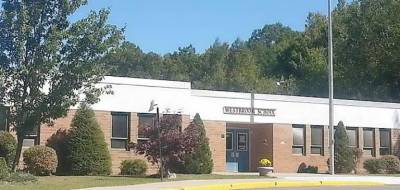
St. Joseph Parochial School students (pictured) in the 1960s could ride to school on public school bus established routes. Special bus routes directly to Our Lady Queen of Peace and St. Joseph Parochial Schools were denied because of possible violation of the law separating church and state. Father Cornelius Kelly is pictured with students. Photo courtesy Irene Bishop Zak
Not much media attention is paid today to the West Milford Board of Education, but 60 years ago, meetings routinely drew reporters and detailed coverage appeared in local newspapers a day or two later. This was long before television news, cellphones and the internet transformed how the public followed local government.
In 1964, controversy surrounded a Board of Education vote to grant Superintendent Mario Grippi a $1,000 annual raise, increasing his salary from $15,000 to $16,000. The vote was 5-4. Trustees Edward Gola, Joseph Toomey, Edward Kitchell and James Gray opposed the raise, while V. Lindsay Chase, Ida Brennan, Robert Gobel, Josephine Warwick and Frank Cathy supported it.
Grippi had earned $9,500 during his first year as superintendent. Gola said he opposed the increase because Grippi’s salary had already risen sufficiently during his four years on the job. Other opponents voiced similar concerns.
That same year, the board approved contracts for five teachers, with salaries ranging from $5,000 to $5,900. Those hired included Evelyn Groch of Fair Lawn and Diane Dohs of Ridgefield Park at $5,000; Dorothea Gorman of West Milford at $5,400; Joan Ensor of Oakland at $5,500; and Irene Hickey of East Paterson at $5,900.
Another issue drawing attention in 1964 was the future of baccalaureate services for graduating seniors. At the time, most districts held non-denominational ceremonies that included reflection, gratitude and spiritual meaning, though with more religious overtones than are common today.
In May 1964, the board debated whether continuing the service might violate the U.S. Supreme Court’s 1962 ruling banning school-sponsored prayer (Engel v. Vitale). After discussion, a five-member majority voted to continue holding baccalaureate services for graduating seniors.
Trustee Josephine Warwick, who voted against the proposal, said local churches should host such services instead. An unidentified woman attending the meeting said she saw no issue with holding a service without a religious theme and did not object to phrases such as “In God We Trust.”
That year, the Lakeland Regional High School Board of Education in neighboring Wanaque refused a “One Nation Under God” pennant offered by a local Veterans of Foreign Wars post. Lakeland BOE President Stephen McGirr, himself a VFW member, urged acceptance to avoid conflict, noting the banner was poorly made and would eventually fade. What became of the pennant is unknown.
Church-state separation also arose in the context of school transportation. In 1964, West Milford provided busing for all students, including those attending parochial schools such as Our Lady Queen of Peace in Hewitt and St. Joseph’s at Echo Lake. Phillips Transportation, located on Greenwood Lake Turnpike, handled the routes, but the question was who should pay.
The board awaited a Supreme Court decision expected later that year. At the time, the BOE supported using public funds for parochial transportation if authorized. Existing interpretations allowed parochial students to ride only on established public school routes.
Opposition came from residents on Blakely Lane, who argued it was unsafe for their children to walk a quarter mile through isolated areas to reach a bus stop on heavily traveled Echo Lake Road. Trustees responded that making one exception would require addressing similar concerns townshipwide.
The issue led to a court challenge by taxpayers Henry F. Fox and Justin J. Jecker, who argued that contracts transporting parochial students violated the First Amendment and the 1947 New Jersey Constitution. Despite the dispute, the BOE later awarded Phillips Transportation a 1965-66 contract to transport parochial students at $69.20 per day.
Over time, parochial enrollment declined and both local parochial schools closed. Rising costs made private religious education unaffordable for many families already paying public school taxes.
One family withdrew four daughters from St. Joseph’s School after the pastor ordered their hair cut to comply with uniform rules requiring hair not touch the collar. When the girls returned without haircuts, they were barred from attending. One week before the eldest daughter’s graduation, all four transferred to public school — a small but telling moment in a larger story of changing times.